Summary
- The lab: ZooOmics, part of Inqaba Biotec, which runs three laboratories, in South Africa, Nigeria and Kenya.
- The problem: Doubtful cases were checked by eye across spreadsheets. 133 samples took a full week.
- What changed: One system analyses each order and explains every mismatch. The analysts confirm.
- The results: Up to 50% less analysis time on large orders. More than 4,500 samples analysed since July 2026.
Inqaba Biotec runs three laboratories, in South Africa, Nigeria and Kenya. Its ZooOmics division tests cattle parentage for breeders: whether a calf comes from the sire and dam the breeder named. Each answer goes into the breeder’s records, so it has to hold up.
A full week for 133 samples
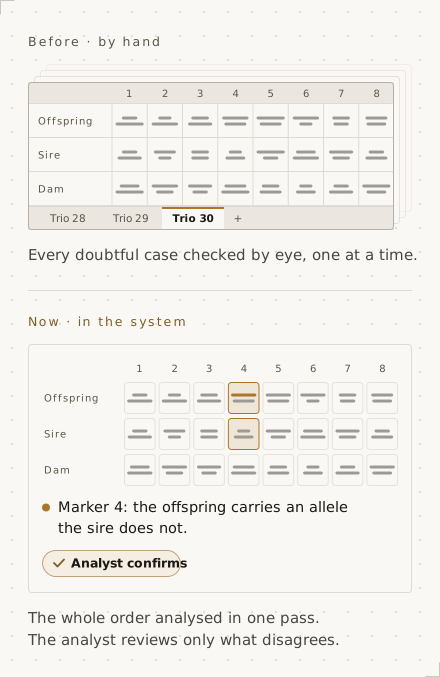
The analysts checked doubtful cases by eye, across spreadsheets. Every batch passed through several tools, and each mismatch was traced by hand, one calf at a time.
“It took me a full, full week to manually analyse all 133.”
The lab’s analyst, product review, 7 August 2026
Every trio meant copying profiles into a new tab before a single allele could be compared. All of it depended on one person.
“When there are 30+ trios (90 individual profiles) that we need to copy to a new tab, in a specific order, and then look at each allele, it takes exceptionally long.”
The lab’s analyst, 3 August 2026
How we built it
Nothing went live on a promise. Each step was checked against the lab’s own work before the next one started.
- On paper first. What the system must do, which files it reads and how the lab would judge it, agreed in writing before any build.
- Built in tested milestones. Each milestone tested on the lab’s own batches, never on sample data.
- Checked against earlier results. Before going live, every answer matched against the lab’s own earlier results.
- Product review, 7 August 2026. The analyst and a colleague put a real batch of 167 samples through it and sent seven change requests.
- All seven delivered, 10 August 2026. Three days later, every request was built, tested and back with her.
- In daily use, 20 August 2026. The lab works in it every day.
- We keep it running. Since then, maintained and changed by RegAid as the lab’s work changes.
What changed
At the product review, the analyst timed her own review in the system and set it against doing the same work by hand.
“It took about an hour or so, less than an hour. But that was just clicking.”
The lab’s analyst, product review, 7 August 2026
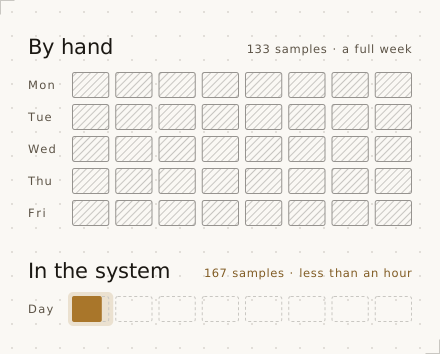
- Analysis time on large orders: up to 50% less, by the analysts’ estimate, depending on sample number and complexity.
- Samples analysed: more than 4,500 since July 2026.
The system now does three things for every order.
- Every case in one pass. Sire, dam and trio, with the likelihood behind each verdict.
- The exact marker behind every mismatch. Explained in plain language, so the analyst reads the reason instead of hunting for it.
- Every decision on record. Who decided what, and when, kept through to the export.
The engine decides. The AI explains. The analyst confirms.
“The app has significantly reduced the time spent on manual parentage analysis, particularly for larger and more complex orders involving multiple possible parents. It has streamlined the overall analysis process, making it quicker and easier to manage while reducing the amount of manual work involved and the risk of errors.”
Senior Laboratory Scientist and Analyst, ZooOmics, part of Inqaba Biotec
How it runs now
The lab runs the system every day. RegAid maintains it and changes it as the lab’s work changes, for as long as the lab needs it.
Large orders now take up to half the analysis time they used to, and the analysts still make every final call.